

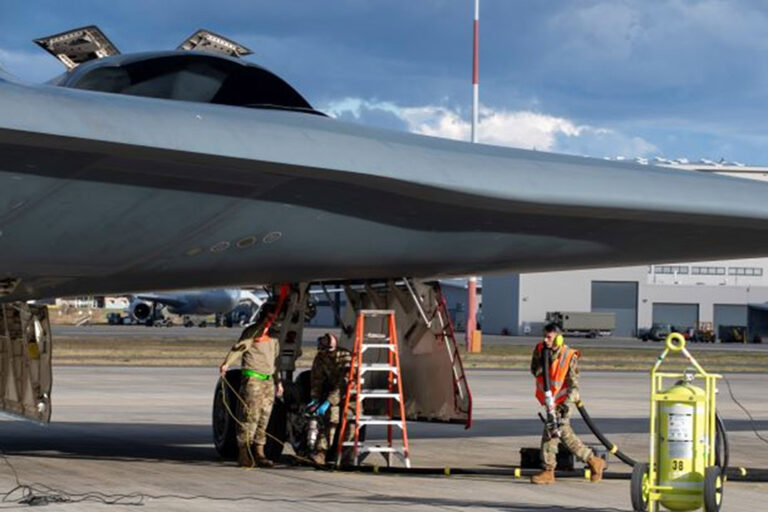
The United States has long maintained a position of military and technological dominance, supported by continuous investment in advanced defense systems. Among its most formidable assets is the B-2 Spirit stealth bomber, an aircraft designed to operate deep within hostile territory while remaining largely undetected. Recent developments indicating an expansion of this fleet, alongside an intensified strategic focus on Iran, have drawn renewed attention to the direction of U.S. foreign policy and the broader implications for global stability.
The B-2 bomber represents a unique blend of engineering sophistication and strategic utility. Its stealth design allows it to evade radar systems, making it particularly effective in missions that require precision strikes against heavily defended or deeply buried targets. Unlike conventional aircraft, the B-2 can travel long distances without detection, carry a wide range of advanced munitions, and strike with a level of accuracy that reflects the evolving nature of modern warfare. This capability positions it as a central component of the United States’ long-range strike arsenal.
The decision to expand the fleet of such aircraft is not merely a technical or logistical development; it reflects a broader strategic posture. By increasing the number of B-2 bombers, the United States signals its intention to maintain readiness for high-intensity operations that may require rapid and decisive action. In the context of Iran, this move is widely interpreted as part of a deterrence strategy, aimed at discouraging actions that could threaten U.S. interests or regional stability.
Tensions between the United States and Iran have persisted for decades, shaped by political, ideological, and security-related differences. These tensions have periodically escalated into confrontations involving economic sanctions, proxy conflicts, and limited military engagements. In this environment, the introduction of additional high-capability assets such as the B-2 bomber can be seen as both a precautionary measure and a statement of intent. It reinforces the message that the United States possesses the means to respond forcefully if necessary.
However, the emphasis on military strength also raises important questions about the balance between deterrence and escalation. While the presence of advanced weaponry can discourage adversaries from taking aggressive actions, it can also contribute to a cycle of mistrust. Each demonstration of power may be interpreted as a threat, prompting countermeasures and increasing the likelihood of confrontation. In the case of Iran, which has invested heavily in defensive infrastructure and asymmetric capabilities, this dynamic is particularly complex.
One of the defining features of the B-2 bomber is its ability to target underground facilities. This capability is especially relevant in the context of Iran, where key military and nuclear installations are often located beneath the surface, designed to withstand conventional attacks. The use of specialized munitions capable of penetrating such defenses highlights the evolving nature of military strategy, where precision and depth are prioritized over sheer scale.
Yet, the effectiveness of such operations cannot be measured solely in terms of immediate tactical outcomes. While advanced bombers can neutralize specific targets, they do not address the underlying factors that drive conflict. Political tensions, regional rivalries, and historical grievances continue to shape the relationship between the United States and Iran. Without addressing these root causes, military actions risk becoming part of a recurring pattern rather than a lasting solution.
Another dimension of this issue is the economic cost associated with maintaining and expanding a fleet of advanced bombers. The B-2 is among the most expensive aircraft ever produced, requiring substantial investment not only in its construction but also in its maintenance and operation. These costs reflect the complexity of the technology involved, as well as the high level of expertise required to sustain it. While such expenditures are often justified in terms of national security, they inevitably raise questions about resource allocation.
In a domestic context, these questions are particularly relevant. The United States faces a range of internal challenges, including economic disparities, infrastructure needs, and social issues that require sustained attention. The allocation of significant resources to military expansion may be viewed by some as a necessary investment in security, while others may see it as a diversion from pressing domestic priorities. This tension between external commitments and internal needs is a recurring theme in policy debates.
The strategic focus on Iran also has implications for regional dynamics in the Middle East. The presence of U.S. military assets influences the behavior of other actors in the region, including allies and adversaries alike. For some countries, it provides reassurance and a sense of security. For others, it may reinforce perceptions of external interference and contribute to instability. The balance between these effects is delicate and often difficult to predict.
In addition, the expansion of advanced military capabilities by one nation can have a ripple effect on global defense strategies. Other countries may respond by enhancing their own capabilities, developing countermeasures, or seeking alliances that can offset perceived imbalances. This process can contribute to an environment of competition, where technological advancements drive a continuous cycle of innovation and response. While such developments can strengthen national defense, they also carry the risk of increasing tensions on a global scale.
It is also important to consider the role of communication in shaping the impact of military decisions. The way in which policies are presented both domestically and internationally can influence how they are perceived and interpreted. Statements emphasizing strength and readiness may be intended to reassure allies and deter adversaries, but they can also be seen as confrontational. The tone and content of public messaging play a crucial role in determining whether actions are viewed as defensive or aggressive.
From an operational perspective, the integration of B-2 bombers into a broader military framework underscores the complexity of modern warfare. These aircraft do not operate in isolation; they are part of a network that includes intelligence systems, support aircraft, and command structures. Coordinating these elements requires a high level of planning and precision, reflecting the increasingly interconnected nature of military operations. This complexity enhances capability but also introduces additional risks, particularly in high-stakes environments.
The ethical dimension of advanced warfare cannot be overlooked. The ability to conduct precise, long-range strikes raises questions about accountability and the human impact of military actions. While technology can reduce certain risks, such as exposure of personnel, it does not eliminate the potential for unintended consequences. Civilian populations, infrastructure, and regional stability can all be affected by military operations, even when they are carefully planned.
In the case of Iran, these considerations are especially significant. The country’s geopolitical position, its internal dynamics, and its relationships with other regional actors contribute to a complex and sensitive environment. Any escalation involving advanced military assets has the potential to extend beyond bilateral tensions, affecting neighboring countries and international interests. This interconnectedness underscores the importance of careful decision-making and a clear understanding of potential outcomes.
Despite the emphasis on military capability, many analysts argue that long-term stability cannot be achieved through force alone. Diplomatic engagement, economic cooperation, and multilateral dialogue are essential components of a comprehensive approach to international relations. While deterrence may prevent immediate conflict, it does not resolve underlying disputes. A balanced strategy that incorporates both strength and diplomacy is often seen as more sustainable.
The expansion of the B-2 bomber fleet, therefore, can be understood as one element within a broader strategic framework. It reflects a commitment to maintaining technological superiority and readiness, while also highlighting the challenges of navigating complex geopolitical relationships. The focus on Iran serves as a reminder of the enduring tensions that continue to shape global politics, as well as the importance of addressing them through a combination of approaches.
In conclusion, the United States’ decision to expand its B-2 bomber capability and its strategic focus on Iran represent a significant development in contemporary defense policy. The move underscores the role of advanced technology in modern warfare and the importance of maintaining readiness in an uncertain global environment. At the same time, it raises critical questions about the balance between deterrence and escalation, the allocation of resources, and the broader impact on international stability.
As the situation continues to evolve, the choices made by policymakers will have far-reaching consequences. The challenge lies not only in demonstrating strength but also in exercising restraint, fostering dialogue, and addressing the root causes of conflict. In a world defined by both capability and complexity, the pursuit of security must be guided by a careful consideration of both immediate objectives and long-term outcomes.